Emotional Flooding
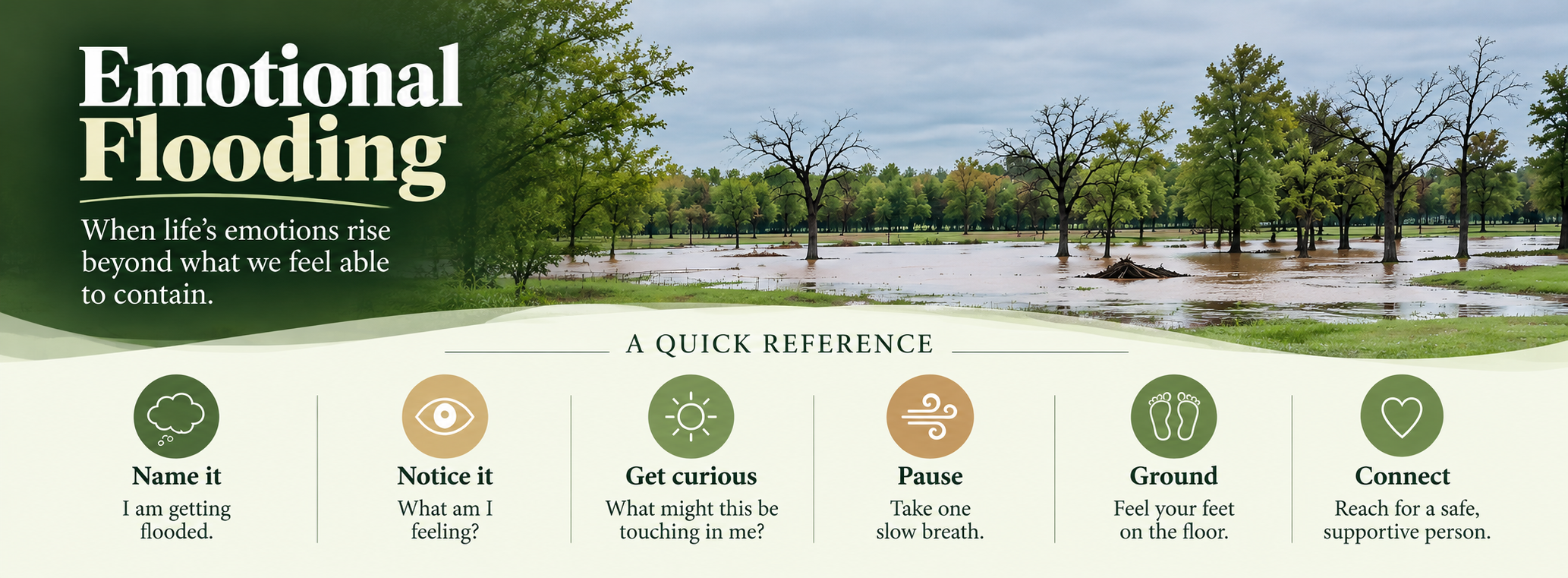
In this last month, we had some torrential rain in Oklahoma. There were days it looked like Niagara Falls coming off the rooftops. We enjoyed the open windows in our dining room, enjoying both the falling rain and the falling temperatures. There were some great moments of beauty! And we also experienced flooding. The big lake got refilled and it was difficult to even tell where the smaller pond was located as the whole pasture looked like one big swimming hole.
There are moments when our emotions feel like this same kind of flooding. It can feel less like something we are experiencing and more like something that has taken us over. In those moments, it can be difficult to think clearly. Our heart might race, we might shut down, become angry, anxious, scattered, defensive, overwhelmed. Sometimes we cannot even identify what we are feeling, we just know that whatever it is it feels like too much. We are flooded.
As I watched the rain and the floods emerge, I started thinking a little about what happens inside us when our emotional systems become overwhelmed. I watched the rain coming down until the water exceeded the boundaries of the pond and spread far and wide. Then the rain stopped, and the water settled. The water slowly receded, and eventually there was the pond again with its clear boundaries. The pond had not disappeared – it had been overwhelmed by more water than it could contain at that moment.
Our emotional lives can work the same way. One stressor becomes two and then three and then ten. Someone might say something to us or we have an experience that touches an old wound. We are tired, worried, rejected, critical, embarrassed, powerless or afraid. And suddenly the water is running over the banks. What looks from the outside like an overreaction may make much more sense when we understand how much water was already in our pond.
Through the model of developmental immaturity, developed by Pia Mellody, we can understand that our present day reactions do not develop in isolation. We learned about emotions somewhere, and typically it is in childhood when we first started receiving messages – those that are spoken and unspoken, overt or covert – about which feelings were acceptable or dangerous and what we are supposed to with those emotions.
Maybe anger was not safe, maybe sadness was weakness. Perhaps you had to conceal fear or worry. Keeping everyone else happy felt like safety and felt more important than recognizing what was happening inside. And as a child, we sometimes cannot make sense of those experiences even while our emotions are working to form. Those experiences influence how we respond when emotional storms arrive years later. Sometimes the situation is happening today, while the intensity belongs to a time long ago. The purpose of understanding is not blame – the power is in becoming curious about our history, so we have more choices in the present.
Emotional flooding does not always look emotional. Sometimes it might look like distraction, forgetfulness, impulsivity, restlessness, difficulty organizing our thoughts or an inability to focus. Those experiences in childhood might be thought to be ADHD or a neurodevelopmental condition, but trauma and chronic stress also impact attention, emotional regulation and executive function. The symptoms of some “disorders” and trauma can overlap, and a person can experience both. Curiosity is important – it helps to shift from “what is wrong with me?” to “what might my nervous system be trying to manage right now?” It might be a nervous system scanning for danger and working to feel safe.
Anytime we have big flood weather warnings, the news says a big message: turn around don’t drown. These are warnings to stop, not proceed, go back and go a different way. And yet, on my drive to work, I noticed an abandoned car, now stuck (abandoned and overwhelmed!) on a flooded road. It made me think about the driver and what may have happened. Maybe the driver was late to work or an important event, maybe they had messages of perfection or fear of being fired. And then they approach the flooded road and the nervous system is challenged to think clearly. Heart range? changes, muscles tighten, thoughts race, and there is an urgency to do something. But thinking clearly can go off line in those moments of flooding.
In those moments of overwhelm, our nervous system might be putting up its own “road closed” sign. Knowing the sign exists and responding to it are two different things. When we sense threat, survival can become more important than reflection. So, we drive straight into the water. A curious question might be “what happened inside me that made me keep moving forward in that moment? "
Emotional regulation does not mean being emotionless or always calm. Emotions carry information, and the work is learning about that information without allowing the flooding to make the decision for us.
When you notice your water rising, you can name it, notice it, get curious, pause, ground and connect.
· Name it: I am getting flooded.
· Notice it: What is happening, what emotion is under my reaction, what am I feeling and where in my body?
· Get curious: What might this remind me of? What is really happening right now in the present?
· Pause: Take a breath, recognize you can pay attention to the closed sign. Reflect on how there are many ways to one destination.
· Ground. Slow your breath. Feel your feet on the floor (or the floorboard1). Remind yourself where you are right now in the present.
· Connect. Sometimes another regulated supportive person can help us find our way back to ourselves.
The storms are part of being human and we cannot stop them from coming. Give the water time to recede. Eventually, the water recedes. In that moment at Green Shoe, the water receded and there was the pond again. Still there, in its same shape, form and space. Flooding had temporarily obscured the boundaries, but it had not destroyed what was underneath. Healing helps us understand where our emotional water comes from. We can examine those messages, recognize our warning signs, develop healthier boundaries, and increase our capacity to experience emotion without being consumed by it.
At the Green Shoe Foundation, our retreat experience provides a space to do that powerful work. Participants explore the experiences and messages that shaped how they relate to themselves, their emotions and other people. It provides a new awareness that we are not trying to eliminate the rain – we are trying to understand the pond.