Hope Is a Method.
Years ago, I remember saying, “I hope that…” I cannot remember the context, but I do remember someone responding, “Hope is not a method.” At the time, I understood what they meant: wishing for something does not make it happen. But years later, as I began learning about the science of hope, I discovered something important. Hope is not simply wishful thinking. Hope can be learned, strengthened, and practiced. . Chan Hellman, professor at the University of Oklahoma and founding director of the Hope Research Center, has spent years studying hope, particularly its role in trauma and adversity. Dr. Hellman defines hope as “the belief that your future will be better than today and you have the power to make it so.” This definition creates hope as an actionable framework.
In our model at the Green Shoe Foundation, we explore five core areas of childhood development: inherent worth and self-esteem, boundaries, reality, dependency, and moderation. When these areas have been impacted by relational trauma, we may enter adulthood having difficulty recognizing our inherent worth, protecting ourselves through healthy boundaries, seeing situations accurately, taking responsibility for meeting our own needs and wants, or living with balance and moderation.
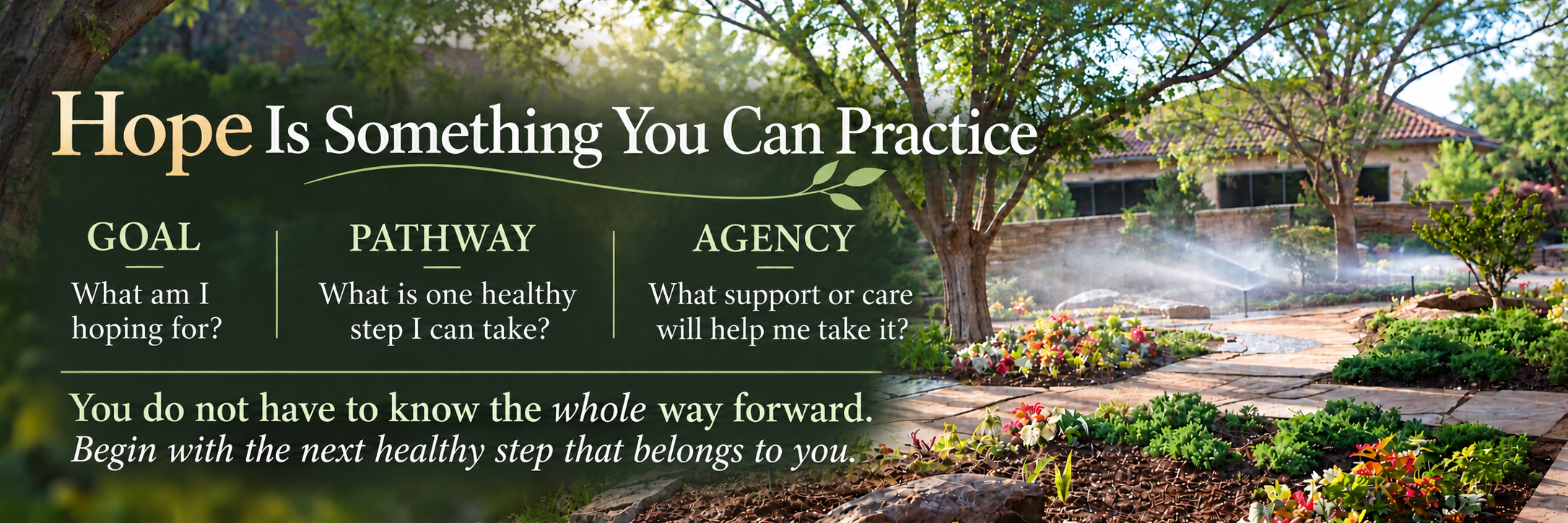
Hope becomes an important part in the process of healing, Dr. Hellman’s work draws on hope theory, which identifies three essential elements: goals, pathways, and agency. A goal identifies where I want to go. Pathways help me identify ways to get there. Agency is the belief and motivation that I can take action along those pathways.
Hope does not require the road to be easy – but hope does help us move forward on the road.
At the Green Shoe Foundation, this is where hope and the Functional Adult intersect. Hope does not require me to deny reality. In fact, healthy hope asks me to acknowledge reality while recognizing that I still have choices about what happens next. The functional adult can say things like:
· This is difficult, and I can acknowledge what is true.
· I cannot control everything, but I can identify what belongs to me.
· I can ask for help and not expect someone else to rescue me.
· I can make a decision without knowing how everything might turn out.
· I can experience emotions without believing that emotion defines my future.
Hope allows two truths to exist at once: this is hard and there is a way forward. When we are exhausted, frightened, ashamed, overwhelmed, or activated by old relational wounds, our thinking can become focused on one question - how do I make this stop? And in that thinking, we often turn to familiar survival strategies like controlling, avoiding, caretaking, shutting down, overworking, numbing, raging, withdrawing, or waiting for someone else to make things better. These strategies may have helped us survive at another point in our lives, and they may even provide short-term relief. But they do not necessarily move us toward the life we want to create.
Hope invites us to ask a different question: “What is the one thing I can do next?” instead of trying to fix everything or being overwhelmed with all the things. We instead identify the next pathway available to us.
What is your hope? Try to make your hope or your goal meaningful and specific. Then think about some pathways – what is one way I can move toward this? Maybe even think about one or two obstacles that might get in the way and explore what you can do when you encounter those.
Agency requires energy. When we are depleted physically, emotionally, or relationally, it becomes harder to recognize choices, imagine alternative pathways, and act on them. Meaningful self-care helps restore some of that capacity. Engaging in self-care provides energy and space for your capacity to strengthen your pathways. Meaningful self-care is not just taking a vacation – think about some other options that might strengthen your capacity in adversity:
· getting enough rest to think clearly
· eating regularly enough to have energy
· moving your body
· spending time with people who help you feel grounded
· creating boundaries around demands on your time
· asking for assistance
· making space for play or creativity
· attending therapy or recovery support
· allowing yourself periods when you are not producing, fixing, or caring for someone else
In the language of the Model of Developmental Immaturity, healthy self-care is also part of learning to appropriately meet our own needs and wants rather than neglecting ourselves, demanding that others take responsibility for us, or consistently taking responsibility for everyone else.
The Functional Adult learns I am responsible for caring for myself, and I am allowed to receive support while I do it. That is interdependence.
We do not have to know exactly how we will reach the destination. We need a meaningful direction and enough flexibility to keep identifying pathways. Healing often works the same way. We may try one boundary and realize it needs adjusting. We may practice caring for a need we were once taught was selfish. We may notice an old childhood reaction and, rather than judging ourselves for it, allow our Functional Adult to decide what happens next.
Each of those moments strengthens hope. My past has influenced me, but it does not have to make every decision about my future.
I invite you to consider a Green Shoe Foundation retreat as one possible next step in investing in your healing. Today does not have to be about figuring out the entire road ahead. Instead, you might ask: What is the next healthy step that belongs to me?
Years ago, someone told me, “Hope is not a method.” Today, I would answer differently. Wishful thinking may not be a method—but hope can be. Hope gives us a direction, helps us discover pathways, and strengthens our belief that we can take the next step.
Healing is not reaching a place where adversity no longer affects us. Healing is increasing our capacity to care for ourselves, remain grounded in reality, and choose a healthy path forward when it does.